
SILKROAD’S GLOBAL MUSICIAN WORKSHOP 2025
PARTICIPANT PAGE
Welcome to Silkroad’s Global Musician Workshop 2025!
This page will act as our home for all things related to GMW. Below, you will find some general information, the schedule, elective class options, and a survey for you to fill out at the end of the week.
+ General Information
Location:
All program activities will take place at New England Conservatory’s Student Life and Performance Center (255 St. Botolph St. Boston, MA 02115)
Parking:
Please note that parking is very limited around New England Conservatory, so we highly recommend that those not staying at the residence hall take public transportation to get to/from NEC. For those who require parking, we encourage using the parking garage at 10 Gainsborough. Alternative options include the Columbus Garage (795 Columbus Ave), North Lot (91 St. Stephen Street), Westland Ave Garage (35 Westland Ave), and Christian Science Plaza Parking (235 Huntington Ave); we also recommend using SpotHero to reserve your space and get the best rates.
GMW Performance Festival:
Find all the information for the GMW Performance Festival at this link.
GMW 2025 Participant Contact List:
Looking to stay connected after GMW? Add your contact information to this spreadsheet.
GMW Spotify Playlist:
Questions?
Contact emily@silkroad.org
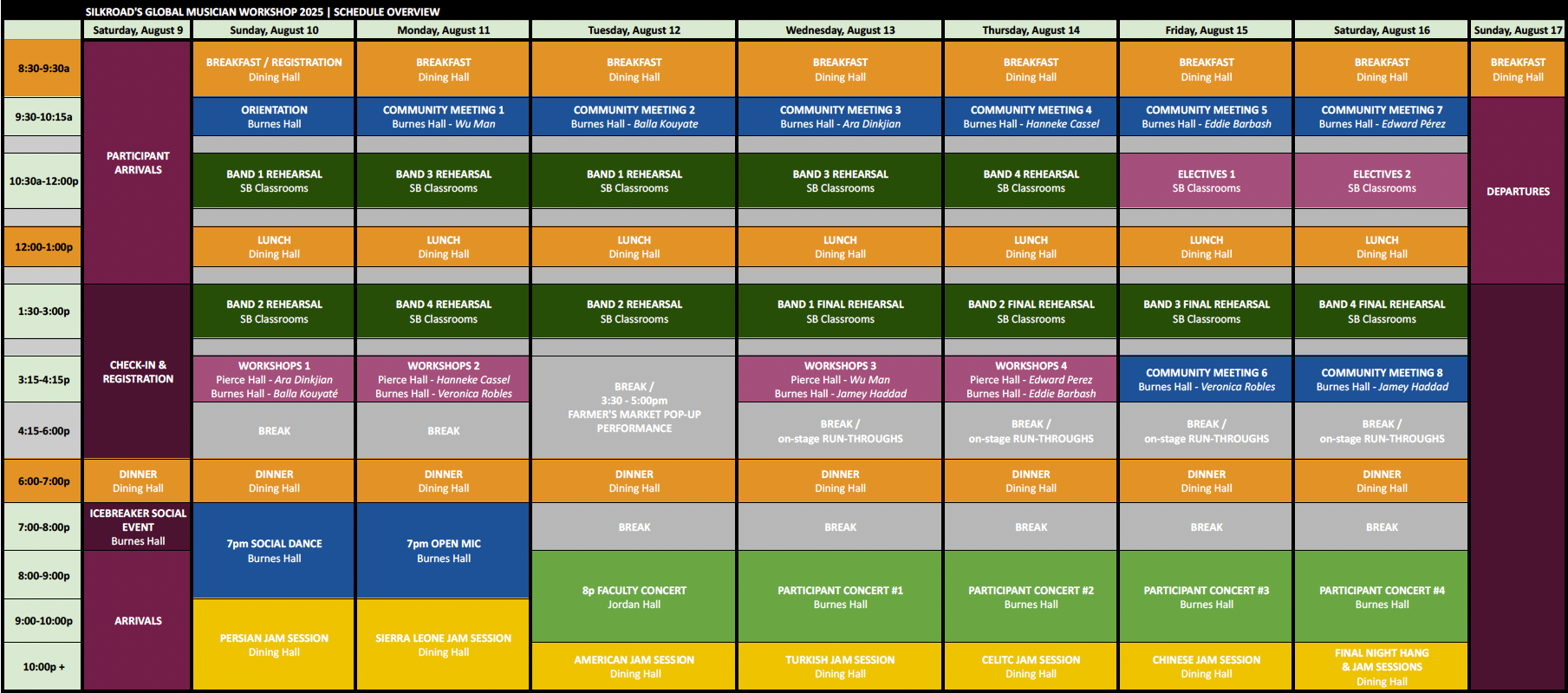
GMW DAILY SCHEDULE
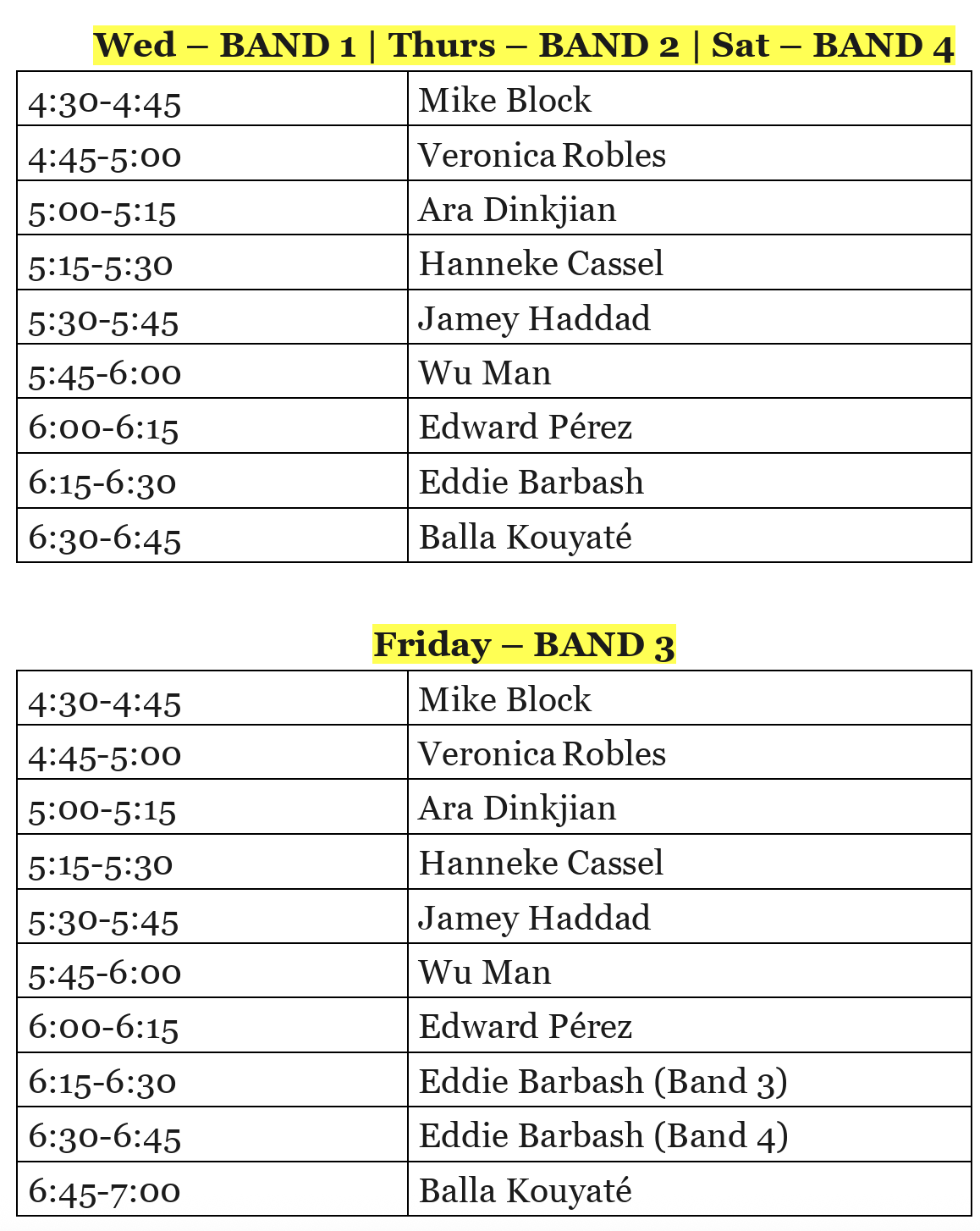
GMW BAND ASSIGNMENTS
ALL-CAMP TUNE
RECORDINGS
ELECTIVE CLASS OFFERINGS
+ Friday, August 15
All sessions will be held between 10:30am-12:00pm. Participants must select one elective class to attend.
A Song in Defiance | Arson Fahim
SB309
August 15th marks four years since the Taliban took over my homeland of Afghanistan and banned all forms of music. Since then, they have shut down the country’s only music school, destroyed instruments, and persecuted musicians. Join us in this jam to learn and play the Attan, Afghanistan’s national dance, as an act of defiance — a way to keep Afghan music alive and in the hearts of musicians around the world, even when it is banned inside the country. Should we choose to, we will also have the option of performing it at the evening concert.
Arranging for Three-Part Vocal Harmony | Timothy Kiah
SB319
Learn how to quickly craft three-part vocal arrangements across a variety of styles and genres. We’ll explore techniques for balancing voices, shaping harmonies, and adapting arrangements to different musical contexts—so you can turn an idea into a performance-ready piece on the spot.
Contemporary Sounds of Sierra Leone| Kate Krontiris
SB318
Step into the vibrant sound world of today’s Sierra Leone. Through listening, discussion, and live music-making, we’ll explore the rhythms, chord progressions, instrumentation, and lyrical approaches shaping the country’s contemporary scene. You’ll get hands-on experience blending your own instrument or genre with modern Sierra Leonean styles, and even try your hand at live music production with artists from Sierra Leone.
Uyghur Dutar Technique and Style | Sohret Nur
SB317
Discover the artistry of two legendary Uyghur dutar masters—Musajan Rozi and Abdurehim Heyit. We’ll examine the history and structure of the dutar, explore essential and contemporary playing techniques, and compare the unique approaches of these masters. Along the way, we’ll discuss how these techniques appear in transcriptions, and the class will culminate with a solo performance inspired by our exploration.
The Classical Music of Iran | Bahar Badiei
SB315
This one-hour session offers an engaging introduction to the history and traditions of Iranian classical music, drawing on its many regional and cultural influences. Through live demonstrations on oud and voice, we’ll explore the modal system, poetic rhythmic patterns, microtonal structures, and approaches to improvisation. Participants will learn a short classical piece and practice applying motifs in improvisation—leaving with both a deeper understanding of the tradition and new creative tools for performance.
Bending the Pulse: Eastern Mediterranean Rhythms for Composers and Improvisers | Stefanos Athinaios
SB316
Explore the rich rhythmic traditions of the Mediterranean and Middle East as powerful tools for improvisation and composition. Using voice, body, and instrument, we’ll break down odd meters, build motifs, shape phrases, and experiment with applying these rhythms in fresh, creative contexts.
Exploring Hicaz Maqam: Ornamentation, Rhythm, and Improvisation in Ottoman/Turkish Music | Eray Cinpir
SB 311
Dive into the maqam system through one of its most iconic modes—Hicaz. We’ll begin with an overview of Rast, Uşşak, and Hicaz, then take a closer look at how Hicaz is structured, ornamented, and performed. Using a song by Alaeddin Yavaşça as our guide, we’ll explore phrasing, expressive details, and the Düyek rhythmic cycle before performing it together in the traditional meşk style. The session will close with a collaborative improvisation, inviting all instruments and voices to join. Open to all musicians—no prior experience with Turkish music required.
+ Saturday, August 16
All sessions will be held between 10:30am-12:00pm. Participants must select one elective class to attend.
Azerbaijiani Songs | Leyla Gahramanova
SB315
An introduction to the rich and varied songs of Azerbaijan. We’ll explore their melodies, lyrics, and cultural contexts, with opportunities to sing and engage with this beautiful tradition.
Finding Your Voice In A New Musical Tradition | Joshua Caraco
SB316
What happens when you play an instrument from one tradition in the musical language of another? Drawing from my recent experience performing Son Jarocho and other Afro-Latin diaspora music on the West African kora, I’ll share practical tips for adapting technique, ornamentation, and phrasing across traditions. We’ll discuss creative approaches to bridging cultures, hear musical examples, and invite an open exchange of ideas from participants’ own cross-traditional experiences.
The Modal Toolbox: Practical Makam for Creative Musicians | Tev Stevig
SB317
Spanning from Morocco to Western China, modal music traditions share deep connections. This session introduces makam as a practical framework for understanding and engaging with this vast musical world. We’ll use the Turkish makam system as our starting point, learning how to hear microtonal inflections, identify key phrases, shape melodic intensity, and explore modulation. Together, we’ll sing, play, and study a short Ottoman piece—leaving with tools to approach modal repertoire, improvisation, and composition with fresh insight.
Persian Rhythms and Rituals: A Cultural Exploration of Daf and Tombak| Amir Etemadzadeh
SB318
Experience the heartbeat of Persian music through two iconic drums: the daf and tombak. In this hands-on session, we’ll learn simple, compound, and asymmetrical rhythms, exploring their role in traditional, spiritual, and folk contexts. Through call-and-response, group exercises, and guided practice, you’ll strengthen your timing, phrasing, and ensemble sensitivity—leaving with a rhythmic toolkit you can use in improvisation, composition, and cross-cultural collaboration.
Middle Eastern Maqam Music and Song | Laith Alattar
SB319
Dive into the melodic language of the Middle East by exploring the main maqams of Arabic, Turkish, Persian, and North African traditions. We’ll examine how these maqams connect through shared building blocks—tetrachords, trichords, and pentachords—and learn how they combine to create different modal colors. Participants will also learn and perform a few simple folk melodies to bring these concepts to life.
Exploring the Spiritual Connection: Late Coltrane and the Guqin | Zishi Liu
SB311
This session explores the deep resonance between John Coltrane’s late works and the ancient Chinese guqin. Through listening, discussion, and guided exercises, we’ll uncover shared themes of emptiness, spiritual seeking, and free expression. Participants will be invited to reflect on how silence, repetition, and open improvisation can shape their own music-making—drawing inspiration from Coltrane’s legacy and the guqin’s meditative voice.
GMW PARTICIPANT SURVEY
Please fill out this survey at the end of GMW. Your feedback helps Silkroad's Global Musician Workshop continue to grow and evolve each year. We welcome your thoughts as we reflect on GMW 2025 and think about how to make future years even more meaningful and impactful.
+ Resources
GMW Forum:
Share photos, videos, comments, and questions at our GMW Facebook Group. Note that this is different from the GMW public Facebook page
GMW 2025 Participant Contact List:
Looking to stay connected after GMW? Add your contact information to this spreadsheet!
GMW Spotify Playlist:
Questions?
Contact gmw@silkroad.org