
SILKROAD’S GLOBAL MUSICIAN WORKSHOP 2024
PARTICIPANT PAGE
Welcome to Silkroad’s Global Musician Workshop 2024!
This page will act as our home for all things related to GMW. Below, you will find some general information, the schedule, elective class options, and a survey for you to fill out at the end of the week.
+ General Information
Location:
All program activities will take place at New England Conservatory’s Student Life and Performance Center (255 St. Botolph St. Boston, MA 02115)
Parking:
Please note that parking is very limited around New England Conservatory, so we highly recommend that those not staying at the residence hall take public transportation to get to/from NEC. For those who require parking, we encourage using the parking garage at 10 Gainsborough. It will, however, be closed for renovations until Sunday, August 4th. Alternative options include the Columbus Garage (795 Columbus Ave), North Lot (91 St. Stephen Street), Westland Ave Garage (35 Westland Ave), and Christian Science Plaza Parking (235 Huntington Ave); we also recommend using SpotHero to reserve your space and get the best rates.
GMW Performance Festival:
Find all the information for the GMW Performance Festival at this link.
GMW 2024 Participant Contact List:
Looking to stay connected after GMW? Add your contact information to this spreadsheet.
GMW Spotify Playlist:
Questions?
Contact gmw@silkroad.org
GMW DAILY SCHEDULE
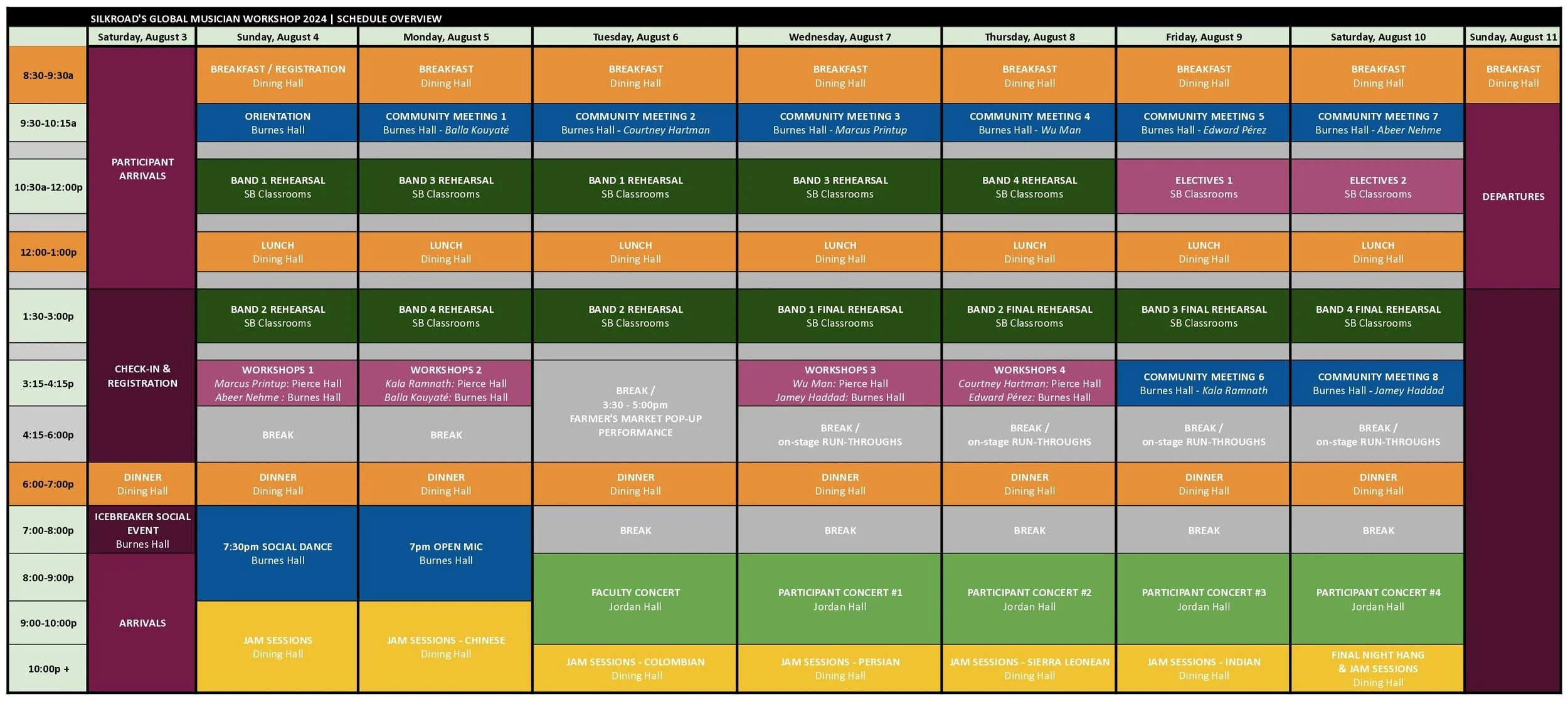
GMW BAND ASSIGNMENTS
ALL-CAMP TUNE
RECORDINGS
ELECTIVE CLASS OFFERINGS
+ Friday, August 9
All sessions will be held between 10:30am-12:00pm. Participants must select one elective class to attend.
The Music of Colombia | Daniel Pardo
ROOM SB311
Colombia's traditional music is rich in diversity due to the geographical context and the merge of Native Indian, African, and European traditions. In this class, I introduce the five regions and respective music/cultural styles: pasillo, bambuco, cumbia, joropo, and modern fusion of styles. Along with the presentation, participants will learn basic rhythmic patterns from Northern Colombia's styles and we will jam (all instruments welcomed) within the modal structure and syncopation practices. I lead the playing portion with a gaita de San Jacinto (Northern Colombia Flute used in cumbia, currulao, mapale, etc).
The outcome of this class is to present participants with an alternate version of African diaspora and ignite curiosity towards the contrasting music styles found in South America.
Playing Your First Jazz Standards | Justin Paschalides
ROOM SB313
Come learn an extremely common jazz standard or two. Learn how to adapt your instrument in way you can call a tune at a jazz jam sessions. We will learn the form of the tune and how to approach improvising on it. Also, we will make time in class for general questions about playing jazz.
Neapolitan Folk Music | Simona De Rosa
ROOM SB315
Explore the Neapolitan folk music through its musical language, dialect and songs.
Sufi Music Traditions of South Asia and Beyond | Dhruv Sangari (Bilal Chishty)
ROOM SB317
An engaging overview of the rich and intense music heritage of the Chishty Sufis from the Indian Subcontinent. The session will involve an introduction to the poetry, musical genres (sama, qawwali etc) history and rituals that have evolved around the mystic tradition of Sufism over the last millennium. Select compositions both hereditary and contemporary set to specific ragas/modes and rhythms/taals by poet-saints from different eras, in diverse languages of expression such as Hindavi, Urdu, Farsi and Punjabi would be performed/vocalized to leave a lasting musical imprint of this unique culture with the attendees. A brief audio visual presentation shall sum up the interactive class ending with a brief Q&A.
Armenian Music: from Pagan to Modern Times | Miqayel Voskanyan
ROOM SB318
Introduction to the rich tapestry of Armenian music through the ages, tracing its evolution from ancient pagan rituals to its contemporary forms. This class dives into the cultural, historical, and social contexts that have shaped Armenian musical traditions, highlighting key composers, genres, and instruments that define its unique identity. By learning about the evolution of melodies, rhythms, and themes, participants will gain a holistic understanding of the cultural heritage embedded within Armenian musical expression.
Playing (and dancing!) for New England Social Dances | Cecilia Vacanti
PIERCE HALL
I will teach a simple tune that is very popular in the American contra dance repertoire, focusing on useful elements of playing a tune for a dance such as groove, improv and arranging choices. We will also all learn a simple dance so that participants can understand the dance tune in context, can try the dance and be able to play the tune for actual dancers.
+ Saturday, August 10
All sessions will be held between 10:30am-12:00pm. Participants must select one elective class to attend.
Survey of Latin American Styles for the Jam Session | Maurizio Fiore Salas
ROOM SB311
Crash course kind of class with the best tips and tricks for approaching some of the most popular styles of Latin American music that you might encounter in a jam session at GMW or otherwise. We will look at how you on your instrument, regardless of which, might be able to approach Afro-Cuban Son, Brazilian Samba, Colombian Cumbia, Caribbean Calypso, Venezuelan Joropo, etc. by looking at general similarities between rhythmic patterns and instrumental roles, so that you can use orchestration to always find something to play!
Palm Wine Music of Sierra Leone, A Fusion with Jazz | Lovelace Love-Harding
ROOM SB313
Palm wine music is not just a musical genre but depicts a social activity that brings communities together. It is often performed at social gatherings, celebrations, and informal settings where people share stories, dance, and enjoy each other's company. The lyrics typically address everyday life, social issues, and personal experiences, often with a humorous or satirical twist.
This session is aimed at creating a unique musical fusion of Palm wine music from Sierra Leone with jazz. By combining the rhythmic complexity, melodic simplicity, and harmonic warmth of Palm wine music with the improvisational and harmonic sophistication of jazz, we aim to produce an innovative and captivating musical experience that honors both traditions while creating something new.
Gumbe-Rhythmic and Harmonic Structures | Harold Nat-Johnson
ROOM SB315
This elective broadens how and why this particular Sierra Leonean genre sounds the way it sounds and the history behind it. The local instruments used and how it has been fused with western music and notation. The almost atonal nature of its melodic lines and polyrhythymic nuances will be discussed and demonstrated in theory and practice.
Introduction to Iranian Traditional Scales called Dastgah | Maliheh Moradi
ROOM SB317
This elective class offers an in-depth introduction to the Iranian traditional musical skill known as Dastgah. Participants will explore the fundamental concepts and techniques that define this musical system. Our vision is to provide a comprehensive and accessible introduction to the rich tradition of Iranian Dastgah.
Indian Ragas and Talas for Cross-cultural Improvisation | Snehesh Nag
ROOM SB318
I'll dive into one of the oldest musical traditions of the world, Indian classical music, and introduce its fundamental concepts–ragas and talas. I'll speak a bit about the sitar, what makes it so unique in terms of both sonic quality and expressivity, and the importance of droning sounds. Using the basic understanding of ragas and talas as tools of improvisation, I will then demonstrate on the sitar both the traditional approach and contemporary approaches (usage in electronic music, for example).
Participants will learn about the sitar and get a basic understanding of Hindustani classical music—its evolution as an art form, what makes it so unique, how some of its ideas can be used in other styles of music, and thinking outside but within tradition.
Bluegrass Cookbook | Sam Stage/Otto Allard/Max Allard
PIERCE HALL
We’ll be taking a practical approach to the core ingredients of bluegrass, what makes this American musical recipe so unique, and how to make it at home. We’ll touch on some classic recordings, the inner workings of the bluegrass groove, improvising in this style, and save plenty of time for playing in groups. Everyone should feel able to survive at a bluegrass jam by the end - plus we’ll include some resources for jam standards and tunes to learn.
GMW PARTICIPANT SURVEY
Please fill out this survey at the end of GMW. Your feedback helps Silkroad's Global Musician Workshop continue to grow and evolve each year. We welcome your thoughts as we reflect on GMW 2024 and think about how to make future years even more meaningful and impactful.
+ Resources
GMW Forum:
Share photos, videos, comments, and questions at our GMW Facebook Group. Note that this is different from the GMW public Facebook page
GMW 2024 Participant Contact List:
Looking to stay connected after GMW? Add your contact information to this spreadsheet!
GMW Spotify Playlist:
Questions?
Contact gmw@silkroad.org